A study evaluating the carbon footprint of lime application in southern cropping systems will help grain growers manage emissions and sustainability credentials in the future.
The University of Adelaide research is part of a Grains Research and Development Corporation (GRDC) investment aiming to provide useful resources to help growers manage acid soils.
Associate Professor Luke Mosley is working with lead researchers Dr Joseph Marks and Dr Thomas Lines to evaluate the carbon dioxide (CO2) released by lime against yield and other improvements it brings.
With carbon accounting becoming increasingly important for sustainability reporting and grain marketing, the team is hoping to establish how much of these emissions are offset by gains in crop biomass and soil health as the soil pH improves.
“Lime is essential for correcting soil acidification caused by nitrogen fertiliser applications and product removal,” Assoc Prof Mosley said.
“However, as the calcium carbonate in lime breaks down in the soil and reacts with acidic compounds, it releases CO2.
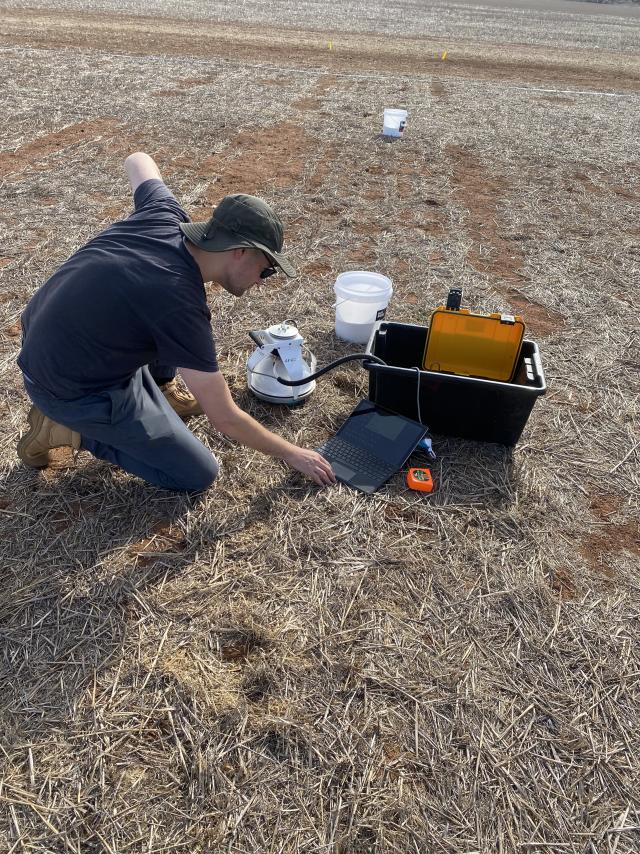
“We will measure these emissions, test whether incorporating lime can help mitigate them, and see if the improved crop growth from limed soil helps sequester a measurable amount of carbon.”
GRDC southern region sustainable cropping systems manager Dr Giacomo Betti said the project aimed to improve the understanding of the development of topsoil and subsoil acidity and limitations to crop profitability.
“Grain growers and advisers in South Australia, Victoria, Tasmania and Western Australia are set to benefit from the research through the knowledge gained and through new and improved management practices they can adopt to manage acidity,” he said.
“We’re hoping to deliver updated extension activities and communication materials to increase growers’ economic returns from lime applications and other management practices to overcome soil acidity constraints to crop production in the southern region.”
Trials are being conducted at established South Australian Research and Development Institute (SARDI)-led, GRDC-funded project sites at Sandilands, Yumali and Spalding.
While these sites were limed several years ago, some plots have been re-treated with lime at four or six tonnes per hectare to monitor how CO2 emissions peak after application.
Both rates have been applied to the surface on some plots and incorporated with a rotary hoe on others to establish whether either option can help reduce emissions.
These results will be compared with untreated control plots at each site.
“We are also taking soil back to the lab at Waite Campus, where we will add lime at different rates and measure the emissions over time,” Assoc Prof Mosley says.
“We can measure CO2 emissions much more intensively under lab conditions, so we will gain a more detailed profile of how the emissions change over time and under different soil moisture conditions, as well as how soil pH responds to the treatments.”
While international studies have shown that variable CO2 release from liming can occur, minimal information exists under southern Australian conditions.
Assoc Prof Mosley said having a better understanding of the carbon equation associated with liming could help farmers manage their emissions and sustainability credentials in the future.
“We want to be proactively measuring these emissions now, so growers can apply locally derived data when they need it rather than having to use an overseas benchmark.”