There is no doubt some older, passionate sheep producers still love their sheep, so when Philip “Pip” Minhard was informed by his sons they were going to convert land previously only capable of grazing stock on their lower Eyre Peninsula property over to cropping, he was apprehensive.
Now several years later, Pip is amazed by the transformation and the first to jump on their header to take the crop off.
Pip’s sons, Michael and James, are third-generation farmers near Cummins, after their grandfather started in the region in the mid-1940s.
They now grow wheat, canola, barley, lentils and faba beans over 2700 hectares and still run some sheep in an area that cannot be cropped.
Soils on their properties range from heavy black clay to sand over red clay, through to deep sands and red ground with limestone.
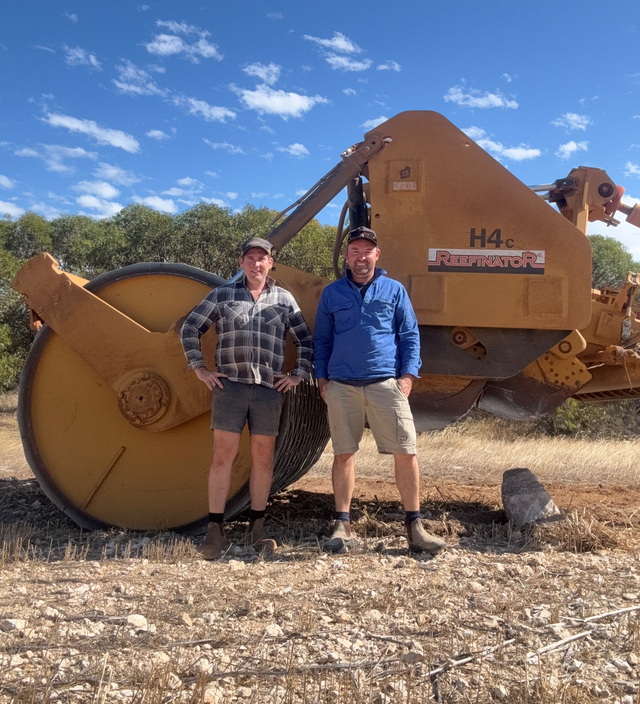
They had some stony reef patches they were circling around in their cropping program and engaged a contractor with a Rocks Gone Reefinator crushing machine to target them, before later investing in their own H4 Reefinator.
“We wanted to reduce the turning around and unnecessary overlapping in the ‘reefy’ areas and our headlands to help streamline the paddocks,” Michael said.
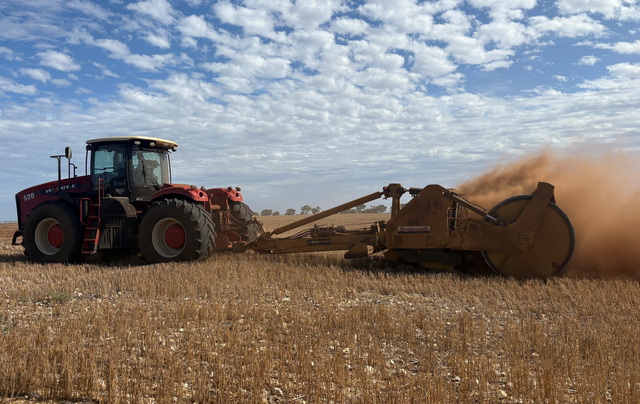
“Our ‘reefinating’ tractor is a wheeled, 520-horsepower Versatile, which was also our seeding tractor. We have since updated the seeding tractor to a new 570hp Versatile, again with dual wheels all-round in case it ends up on the Reefinator.
“We find wheeled tractors give more cushion and give when it comes to ‘reefinating’ in tough conditions.”
The three-metre wide H4 Reefinator comprises a levelling blade, four front row and five rear row hydraulic tines, and a following ribbed drum, all weighing 28-tonne when filled with water and digging up to 600 millimetres deep.
The brothers then tackled a whole paddock of rocky country that had grown good stock feed, but it was too rugged for machinery – hence why it had never been cropped.
“Dad was fond of the sheep and he thought we were mad,” Michael recalled.
“The paddock was 150 hectares and we did 70ha with the Reefinator in the first year there, doing five to six passes before planting it to canola.
“By the fifth pass, we had worked it to a depth of three to four inches.”
The rugged work caused some stress on the tines and adaptors, and also broke the tractor drawbar.
The Minhards finished “reefinating” the remaining 80ha of the paddock the following year and have since targeted another 73ha grazing paddock, where they were undertaking further passes with the machine only recently.
“We have completed most of the broader areas and we have continued to do smaller ‘reefy’ bits where we are trying to grow lentils,” Michael said.
“Some of the smaller areas have had up to 10 passes and we knock up to 500 millimetres off the top of sharp knobs and leave the paddock more level.
“We will keep doing little knobs and areas, and then we may go back to where we started for more passes. The deeper you get; the better results for crop yields.”
Michael said their travelling speed with the machine was a “happy medium” that helped to keep them in the tractor seat whilst continuing to “bust through rock” without stopping.
The speed then increases with subsequent passes.
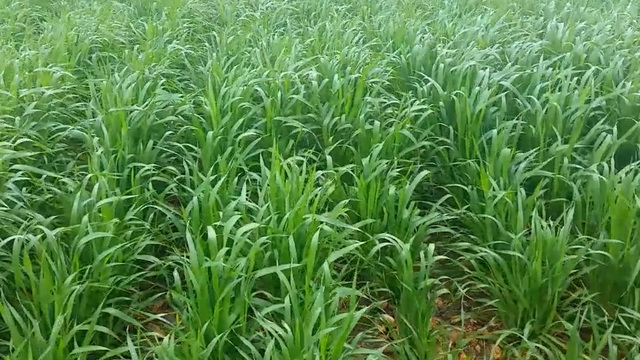
He said the crops produced on the larger areas were equal to elsewhere on the property, while the land value had increased considerably.
“Without much fertiliser history, we produced 2.6-tonne (per hectare) of canola and the better stuff elsewhere was about 3t (/ha). Then the wheat went about 4t (/ha),” Michael said.
“Last year, we ran out of moisture and the canola on the rocky reef areas went about 2t (/ha) and the wheat 2.6-2.7t (/ha).
“As grazing country, it might have been $1800 an acre, whereas now as cropping, it’s probably up to $5000/ac.”
The Minhards used a similar seeding fertiliser strategy for the rocky paddocks, applied through their John Deere ConservaPak bar and Flexi-Coil air cart sowing rig.
Michael said the tines move significantly in the rocky country and they had to re-bush the bar and replace a few points.
As a result, they seed at a slower five to six kilometres per hour in these areas compared with about 8.5km/hr elsewhere.
Rocks Gone Reefinator machines have been used elsewhere on Eyre Peninsula and Michael said he believed there was still further opportunity for land improvement, particularly considering many limestone areas still received reliable rainfall, especially along the western coast.