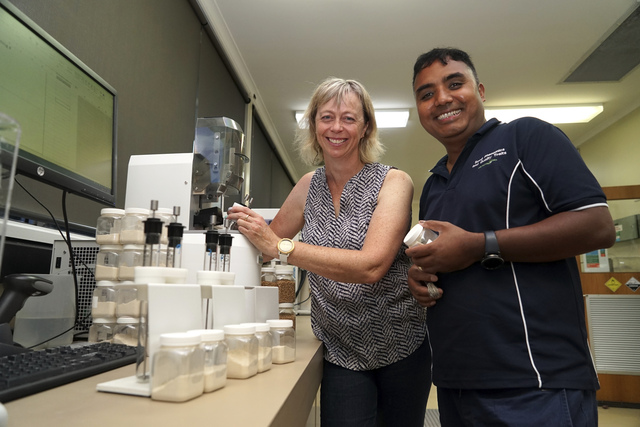
Grain growers generally experience anxiety when the falling number test machine comes out at harvest, but new preliminary research findings suggest wheat falling number test results could improve with time in storage.
The findings are part of a new research investment by the Grains Research and Development Corporation (GRDC) and Agriculture Victoria, supported by New South Wales Department of Primary Industries and Regional Development (NSW DPIRD) and LongReach Plant Breeders.
This research explored the possibility of falling number test results improving due to grain being stored.
While growers have reported this anecdotally, until now the concept had not been scientifically tested.
GRDC grain storage extension team lead Chris Warrick said trials by Agriculture Victoria’s research team at Horsham SmartFarm indicated wheat falling number could increase by up to 50 seconds and even exceed 300 seconds post storage.
In contrast, barley did not show an increase and further research was needed to understand the differences.
While Mr Warrick said the preliminary results were encouraging, further research was needed to test the results across more varieties to better understand how growing and storage conditions might influence a change in falling number.
Preliminary findings indicate:
– Wheat with an initial falling number test result exceeding 250 seconds has the potential to increase and surpass the 300-second threshold required for various Australian wheat grades during storage.
– While cold storage is best for mould and insect prevention, storing wheat at 25-30 degrees Celsius may increase the likelihood of increasing the falling number test results compared to colder temperatures.
– The wheat used in this research had a moisture content of 11 per cent and was stored at 45 per cent humidity. The impact of varying moisture levels on falling number changes is still unknown.
– Preliminary research shows that increasing the falling number by 40-50 seconds took four to six months.
Agriculture Victoria research leader Cassandra Walker said research found where wheat had an initial falling number of less than 250 seconds, no change in falling number was observed.
“We are not talking about magic, specific storage conditions are essentially an attempt to stop the very early stages of germination,” she said.
Mr Warrick said while the research was preliminary it had yet to be replicated in farm storage conditions.
“We are sharing these early results to give growers the opportunity to decide if they want to try storing wheat that doesn’t quite make the 300-second falling number test and see if it improves with storage,” he said.
“We certainly don’t want to create an expectation that these results will be replicated in all conditions, there are still many variables and influences we need to understand through further research.”
Mr Warrick reminded growers that aside from falling number considerations with storage it was also critical they prioritised safe grain storage practices, including regular monitoring of grain temperature and moisture, and using a sieve and probe traps to detect insects.
“It would be counterproductive if we chase an increase in falling number at the expense of letting grain go mouldy or become damaged from insect pests such as weevils,” he said.
“We aim to cool grain immediately after harvest to maintain seed viability, preserve grain colour, prevent mould, and deter insects.”
Mr Warrick said in theory operating aeration cooling fans as usual for the initial phases as soon as the storage was full, then reducing fan runtime once grain temperature was in the 25-30 degree Celsius range, to delay further cooling for grain moderately low in falling number could have positive outcomes for the falling number test result.
“As soon as the target falling number result is reached, if it’s reached, then aeration cooling would be continued to provide safer storage conditions, reducing the chance of spoilage from mould or insects,” he said.
Mr Warrick said the research could have significant benefits for Australian growers if well managed storage could help wheat reach the next grade to return an extra $50-$150/tonne.
“GRDC’s proactive approach in recognising the opportunity to conduct preliminary research when conditions presented at short notice could prove a major game changer for growers,” he said.
For more information on managing grain in storage, download a copy of the GRDC Grain Storage GrowNotes from storedgrain.com.au or call your nearest grain storage specialist on 1800 WEEVIL (1800 933 845)