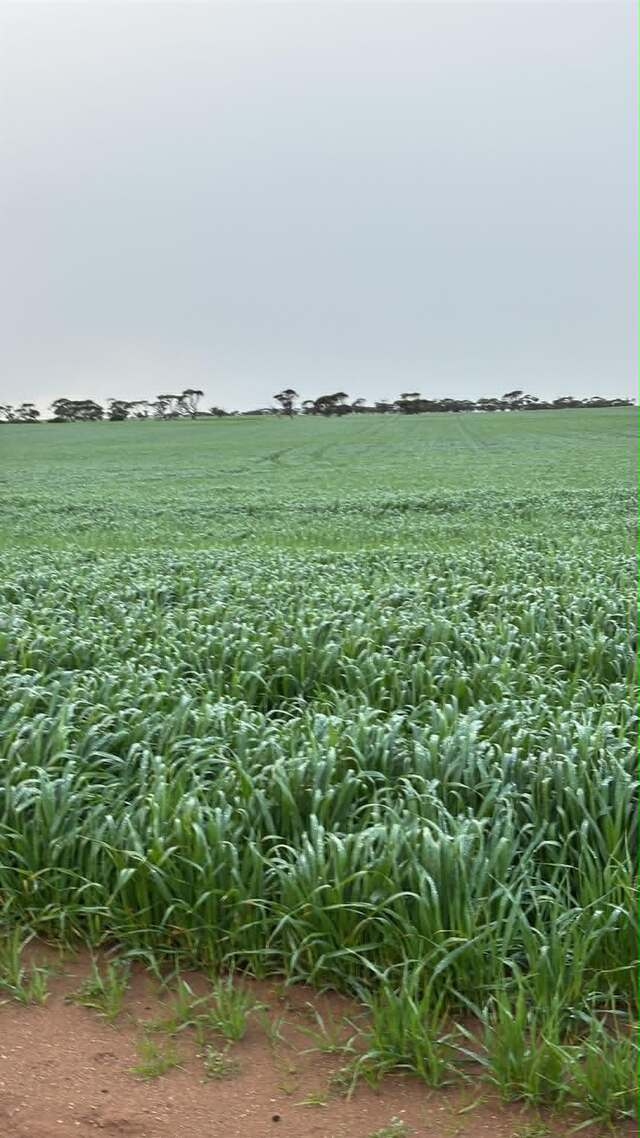
Streaky Bay farms are on track for a bumper cropping season with rainfall totals across the district already eclipsing the annual average, but local farmers remain mindful it is not in the silo yet.
Where this time last year Streaky farms were under the stranglehold of drought and consecutive low rainfall years, local enterprises are now on track for record crops, with between 300mm and 400mm having fallen across the district by late June.
Fourth-generation farmer Dion Trezona – who operates his family’s farm roughly 40 kilometres north-east of Streaky Bay – said it was possible the region could see yields in the 2022 ballpark; a year in which close to 600mm fell and record harvests were reaped.
“Everyone you talk to is up and about, everyone is absolutely stoked that we’re not still hand feeding sheep in the middle of June, like we were last year,” he said.
“At this stage, it’s pretty close to the 2022 rainfall, in terms of what we’ve had to date compared with the same time that year, so the potential for 2022 to happen again is pretty good.
“We had a heap of rain early that year as well, but it might have been too early, we all had to go and do a lot of spraying for Lincoln weed.”
However, Mr Trezona said the timing of this year’s rain had been impeccable.
“We’ve managed to get a lot of growth in our crop while our soil temperature is still warm, we haven’t had a frost event yet for things to cool down to the point where they go dormant,” he said.
“We haven’t had the sub two-degree nights yet, that’s where your soil temperature gets real cold and your plant goes into a dormancy or slow growth mode.
“So all this rain at the moment is just pure bulk that your plant is growing, it’s bloody magnificent.”
However, Mr Trezona said his business had chosen not to over invest in what remains a “potentially” good season.
“I didn’t go and buy myself another road train of urea or anything, it would still only be a maybe on whether you get a return on each dollar you’d spend, because it’s not in the bank yet,” he said.
“This crop that’s in the ground, some are still only three or four leaf, it’s not at the end of tillering. Everyone knows you can make money when it rains in spring, so we’ve got a long way to go before the bank balance starts showing any upside of what the last three years have cost us.”
Strong El Nino predictions also have Mr Trezona somewhat tempering expectations.
“They’re still forecasting a chance of it being below average rainfall with this El Nino event, so you’ve gotta have it in the back of your mind that it could still be a dry September, and everything goes to 15 per cent screenings like it was in 2003 or 2004,” he said.
“We had this magnificent start to that year and then it didn’t rain again, and we were reaping above average crops, but they were 15-18 per cent screenings.”
For many farms across the Streaky region, flowering is also likely to occur in the local frost window.
“Everyone got to sow their crop from the middle of April to the start of May; Minnipa Ag Centre has always said that the best possible return, the best years you ever have, is when your crop is flowering between September 1 and 5,” Mr Trezona explained.
“We know that’s right in the frost window, if you can get it flowering and you don’t get a frost, that’s when everything is going to be sweet, but because everyone managed to sow early this year, everyone will be in that frost window, so it’ll be in the back of everyone’s mind.”
Irrespective of the exceptional early rainfall, Streaky farms will still need late winter and early spring rains.
“Up our way it will dry out fast enough, the bulk of the plant is there now, but we’re still going to need rainfall in August and September to finish the crop,” Mr Trezona said.
The farmer also noted that such high rainfall presented a variety of challenges for enterprises.
“Some people will be starting to get a bit worried about disease in their crop, especially anything that’s canopied up, and then it goes into a dormant phase, there might be some blotches and rust starting to form,” Mr Trezona said.
“Because we’ve had so much cereal grain already growing in our pasture ground since February – everyone’s got some self-sown barley and oats and the rest – that’s potentially already bred up some disease, so there’s going to be a bit of caution around the disease side of things.”
He also noted some farmers were dealing with difficulties spraying due to soft paddocks and rain delays.