Expanding domestic crushing capabilities will be key to scaling up Australian canola production in the future, according to new research.
Rabobank says Australia has the capacity to lift its average annual production of canola – the country’s primary oilseed crop – to about seven million tonnes a year over the next 10 years, up from recent annual averages of 6.5 million tonnes.
This can be made possible by “structural gains” in cropping area, genetics and agronomy practices.
However, the report – ‘Harvesting the future: How far can Australia scale canola crushing?’, by the bank’s RaboResearch division – cautioned that without a material expansion in domestic crushing capacity, canola’s production growth would likely “remain incremental and variable”.
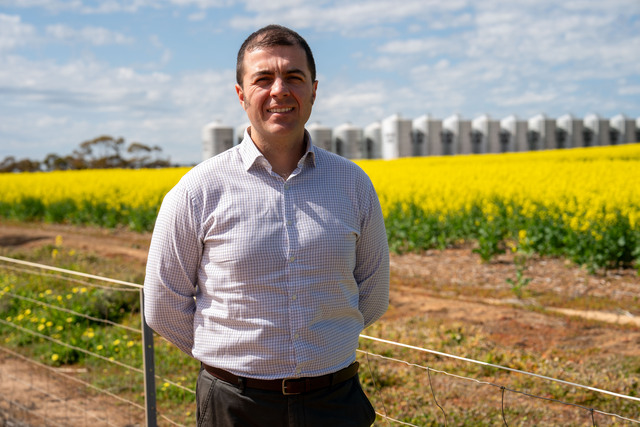
RaboResearch senior grains and oilseeds analyst Vitor Pistoia said growing global demand for biofuel has seen Australia’s canola sector respond with significant supply growth in recent years, however this had primarily been in the form of increased canola seed exports to be crushed offshore.
“Australia’s export-led system has responded to global demand growth largely through higher canola seed exports rather than by expanding domestic crushing capacity (to enable oil exports),” he said.
“This has limited the extent to which that demand growth is translated into local value-adding, job creation and more stable domestic price formation.”
The report said expanding local canola crushing capacity could result in improved price stability and boost grower confidence.
“Regions in Australia with higher canola-crushing density already exhibit more stable pricing dynamics than export-dependent zones such as Western Australia,” Mr Pistoia said.
“Expanding crushing capacity in Australia would absorb surplus supply, stabilise basis and reduce volatility, creating a positive feedback loop that supports grower confidence, sustained area and long-term supply growth.”
Mr Pistoia said a comparison of Australia with other major canola-producing regions in the world, such as Canada, highlighted the importance of domestic processing in supporting area expansion.
Canola accounts for about 14 per cent of Australia’s winter cropping area compared with about 28 per cent in Canada, where a large crushing industry underpins stable demand.
“In Canada, a large share of canola production is absorbed by domestic crushers, creating a stable demand base that supports persistent cropping intensity alongside exports,” Mr Pistoia said.
He said expanded domestic crushing in Australia would support a lift in total winter canola cropping area and more persistent canola plantings over time.
The report said Australian canola area has increased at an average rate of around 3.5 per cent per year since the early 2000s and is projected to reach 4.1 million hectares, or around 16 per cent of Australia’s winter cropping area by 2030.
“Over the past two decades, production and planted area have expanded steadily, supported by varietal improvements, advances in agronomy and buoyant export demand, particularly from Europe and Asia,” Mr Pistoia said.
Assuming continued area growth, national canola output is expected to reach about seven million tonnes a year.
In renewable diesel terms, this equated to about 2.4 billion litres a year, Mr Pistoia said.
Over the past five seasons – 2021-22 to 2025-26 – canola area has averaged around 3.4 million hectares within a total winter cropping area of approximately 24.1 million, indicating recent growth has been “incremental rather than transformational, with the share of the cropping mix still relatively low, despite price increases”.
Mr Pistoia added canola was generally “viewed as a high-value break (rotational) crop” within cereal-based farming systems, although now for some regions it was a core element of the cropping program.
“Canola delivers rotational benefits, but remains sensitive to seasonal conditions, with moisture availability during establishment continuing to impact year-to-year outcomes.”